
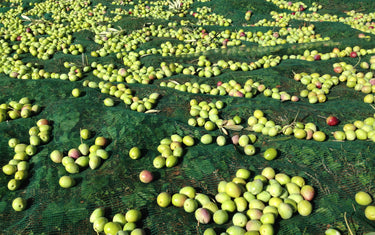

The word organic appears on so many products now that it has started to lose its edges. You see it on shampoo, on cotton t-shirts, on wine, on baby food. Sometimes it means something precise and legally verified. Sometimes it is doing very little work beyond making the packaging feel virtuous.
For food produced and sold within the European Union, organic is a legally defined term. It is not a marketing category. A producer cannot decide their product is organic because they feel it deserves to be. They have to prove it, annually, to an independent certifying body.
What follows is an explanation of what that actually requires, and what conventional farming involves by comparison. Not a polemic. Just the facts, as clearly as I can state them.
What conventional farming uses
Conventional agriculture in Europe operates under a legal framework that permits the use of synthetic pesticides, synthetic mineral fertilisers, and herbicides, subject to EU-level approval. The substances must pass a safety assessment before they can be placed on the market, evaluating risk to human health and the environment. Approved substances are reviewed periodically.
What this means in practice is that a conventionally farmed olive grove can be treated with synthetic fungicides when fungal disease threatens the trees, synthetic insecticides if pests become a problem, synthetic herbicides to manage weeds between the trees, and synthetic fertilisers to replenish nutrients in the soil.
These tools are effective. That is why they are used. They allow farmers to protect yields, manage labour costs, and produce consistent results across large areas. This is not corruption. It is the logic of industrial-scale agriculture.
A scientific analysis published in the journal Environmental Sciences Europe compared 256 pesticide active substances permitted only in conventional EU agriculture with 134 substances authorised for organic farming. The study found that 55% of the substances used exclusively in conventional agriculture carried health or environmental hazard classifications, compared to 3% of substances permitted in organic farming. Warnings about possible harm to unborn children, suspected carcinogenicity, or acute lethal effects appeared in 16% of the conventionally approved substances, and in none of those approved for organic use. (Winkler et al., 2022 — full reference in sources below)
This does not mean conventional food is dangerous. It means the inputs used differ substantially in their risk profile, and that difference is measurable.
What organic farming prohibits
Certified organic producers in the EU cannot use synthetic pesticides. They cannot use synthetic mineral nitrogen fertilisers. They cannot use synthetic herbicides. GMOs are prohibited in all forms. These are not guidelines. They are conditions of certification, verified by annual inspection.
What organic farmers can use instead is a much shorter list of approved natural substances, defined by EU authorities. For olive growers dealing with fungal disease, copper-based treatments are permitted, within strict limits on annual quantities. Sulphur is permitted against certain pests. Biological control agents, pheromone traps, and physical barriers are used to manage insects. For soil fertility, the approach shifts to composting, green manure, and natural mineral inputs that release nutrients slowly rather than all at once.
The shift matters more than it might sound. Synthetic nitrogen fertilisers deliver nutrients rapidly and efficiently, which drives fast growth and high yields. Organic soil management works differently. It builds the microbial life of the soil over years, creates a more complex nutrient cycle, and produces slower growth that is, in the view of many agronomists, more resilient over time but less predictable season to season.
The three-year conversion period
This is the part of organic certification that most people outside farming have never heard of, and it is the part that matters most.
An olive grove cannot simply be declared organic. If a grove was previously managed with conventional inputs, European organic law requires three full years of organic management before the first certified harvest. Three years of farming without synthetic inputs, without being able to label or sell the oil as organic, and without the price premium that certification brings. The trees and the soil have to clear the chemical legacy of conventional farming before the certification can be granted.
Olive trees are perennial. They live for centuries. A tree that received conventional treatments for twenty years does not become organic because the farmer decided last spring to change approach. This is why the conversion period exists and why it is measured in years rather than seasons.
It is also why organic certification for olive oil is meaningful in a way that some other organic claims are not. The producer has had to commit years, not months, before seeing any return on that commitment.
The annual inspection
Once certified, the work does not stop. European organic rules require a full inspection at minimum once per calendar year by an approved certifying body. The inspector verifies that farming practices match the records. They check what inputs were purchased, what was applied, when and how. They can take soil samples or tissue samples. If the records are incomplete or the practices do not match the certification requirements, the certificate can be suspended or withdrawn.
What this means for olive oil specifically
Olive oil carries whatever the grove carried. Pesticide residues that enter the olive during the growing season can end up in the oil.
Certified organic olive oil has been produced without synthetic pesticide inputs, verified by a third party, across a minimum three-year period before the first certified bottle left the producer. That is a concrete and specific guarantee.
There is one nuance worth naming honestly. Organic certification is a farming standard. It is not a taste guarantee, a freshness guarantee, or a polyphenol guarantee. A certified organic olive oil can still be old, poorly stored, or made from over-ripe fruit. Organic tells you how the grove was managed. It tells you nothing about what happened at the mill or in the warehouse afterwards.
This is why, when choosing olive oil, organic certification matters alongside the other indicators we have discussed elsewhere: harvest date, named variety, specific origin, and if possible, the ability to taste before you buy.
Our own position, for transparency
Our Buža and Rosinjola oils carry EU organic certification. The grove where those trees grow completed the three-year conversion period and has been inspected annually since.
Our Ulìa blend includes oil from trees that are still moving through that conversion process. Some of those trees were previously managed by other farmers and the three years have not yet elapsed. Farming practices on those trees are the same as on our certified trees. The certification paperwork is not yet complete.
We say this directly because we think you should know it. Ulìa is not organic certified. It is farmed with care. Those are related but not identical statements, and the difference between them is exactly what this post is about.
Sources:
EU Regulation 2018/848 of the European Parliament and of the Council of 30 May 2018 on organic production and labelling of organic products. Official Journal of the European Union.
Commission Implementing Regulation (EU) 2021/1165 authorising certain products and substances for use in organic production.
European Commission, Directorate-General for Agriculture and Rural Development. Becoming an Organic Farmer. agriculture.ec.europa.eu.
Winkler et al. (2022). Toxicological Comparison of Pesticide Active Substances Approved for Conventional vs. Organic Agriculture in Europe. Environmental Sciences Europe, 35, 8. Published via PMC/NCBI.